

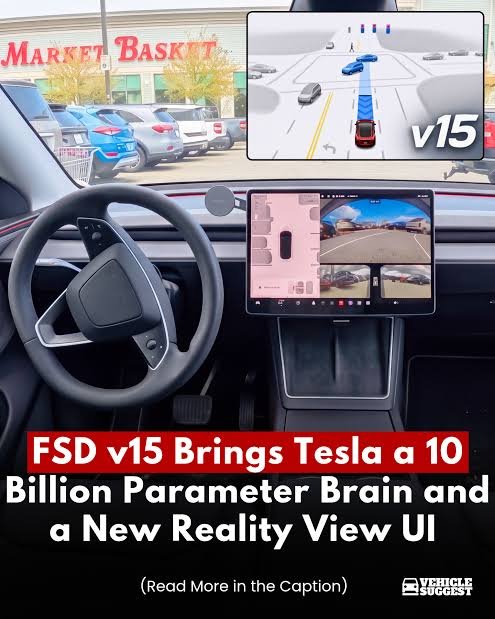
Tesla has begun implementing an AI system that changes how driving environments are depicted on the company’s in-vehicle displays. During a recent video, Elon Musk said this system replaces conventional polygon-based graphics with an advanced diffusion model containing close to one billion parameters.
This system is based on a Conditional Mean-Flow Diffusion Model and includes a separate driving model also based on a Universal Vision Encoder containing three billion parameters.
The encoder operates at 18Hz. In order to create visuals, the AI increases noise in the previous frame and removes it over the course of four iterations using eight frames at a time. It can currently generate images at 36 frames per second.
New AI Rendering Tech Explained
Tesla has allegedly optimized this system by moving a smaller decoder to on-chip SRAM and also moving a portion of the larger decoder to one of the three TRIP accelerators in the SoC B processor. Overall, it’s been said this reduces the workload by a factor of two.
Each of these accelerators uses 28 steps to emulate a softmax function using 8-bit operations.
Current tests of the system have reported delays of approximately 0.5 to 1 second between what the driver is actually seeing and the graphics displayed on the screen.
Musks has said changing the transformer architecture to incorporate recent changes in the field could reduce this latency by 35%.
In the meantime, the focus has been on enhancing visuals. Testers have said that despite these enhancements, there are still one to two second delays between the actual scenario and the image being displayed. So far it’s unclear if these updates improve safety.
Visual Improvements, But No Evidence of Improved Safety
Newer, more realistic graphics may sway some customers toward Tesla. Full Self Driving (FSD) systems still require driver supervision, making the new tech a Level 2 system at best.
Visual improvements do not equate to improvements in driving safety. There are still many dangers associated with using an automated driving system. Drivers can become distracted and complacent, increasing the likelihood of an accident.
It’s unclear how the improvements have been measured. A benign baseline would help assess the improvements, but Tesla hasn’t published one. At best, FSD is considered a Level 2 system.
There are numerous other unanswered questions as well. Independent verification of the performance metrics of the system is lacking.
Tesla also claims to have achieved a 25-fold improvement in critical interventions, but fails to provide a performance baseline.
Hardware 3 equipped vehicles will not get the new feature. Latest estimates predict roll out will occur by December.
Tesla has recently focused on integrating AI to improve the graphics and real time rendering capabilities of the vehicles.
Now a bit more about this latest feature. Called ‘Reality View’ it will only work with newer vehicles containing AI4 hardware. Owners of older Hardware 3 equipped vehicles will not get this feature. Effective use of AI will likely vary depending on the capabilities of the hardware it’s installed on. Independent testing will be required to verify actual benefits of the feature.